
In this article:
- What structural fasteners are and which standards apply
- Hot-dip galvanizing: advantages and limitations
- Zinc flake coating: advantages for structural fasteners
- Hot-Dip Galvanizing vs. Zinc Flake Comparison Table
- Industry Applications
Structural Fasteners and Their Critical Role
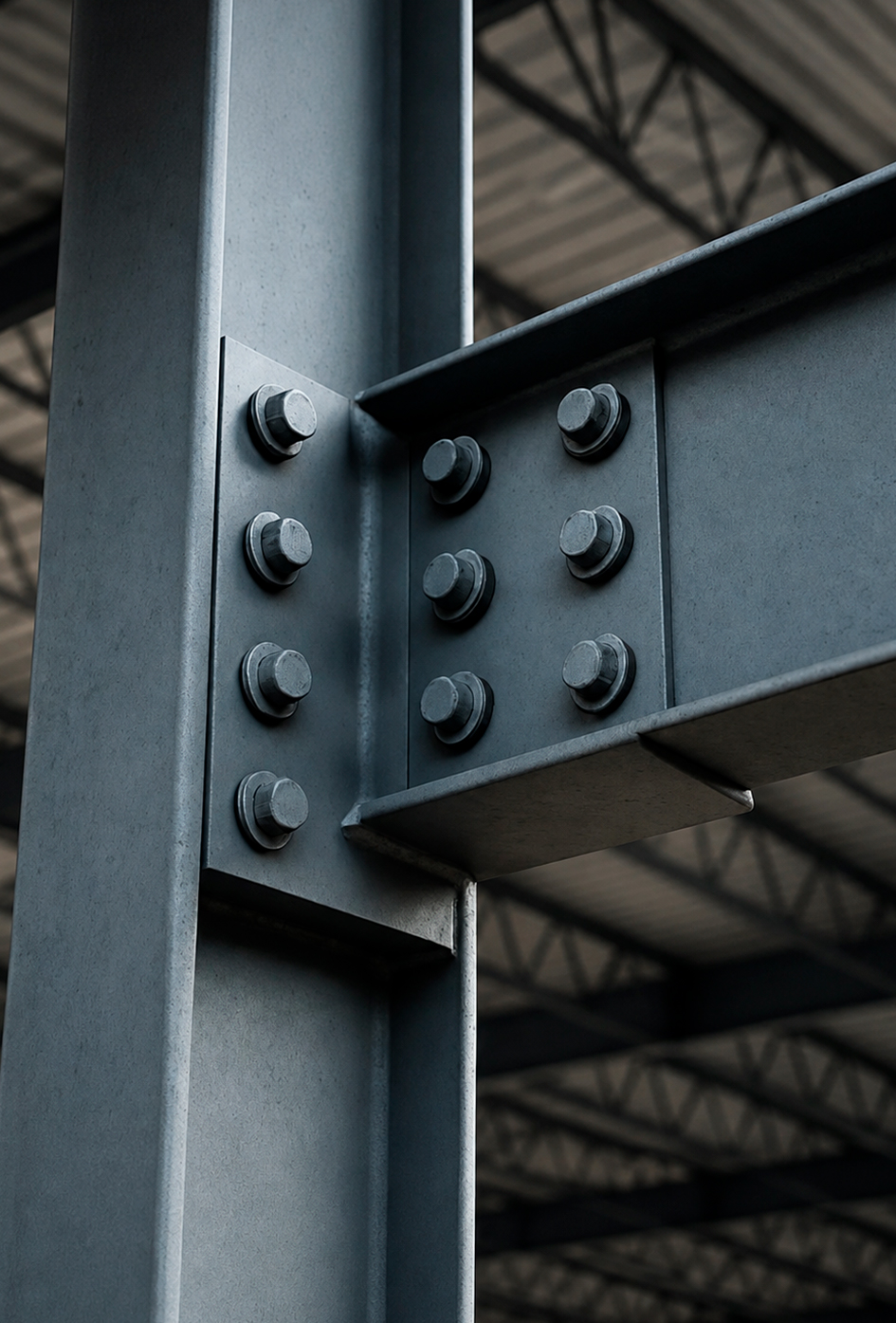
In steel structures, structural fasteners are not a secondary component. They are what holds the structure together—under static loads, dynamic loads, vibration, and constant environmental exposure.
A failure in a structural fastener is not a minor issue. It can compromise the integrity of the entire structure, generate significant maintenance costs, and, in critical cases, represent a risk to operational safety.
For this reason, selecting the corrosion protection system for structural fasteners is an engineering decision that deserves the same level of attention as selecting the steel grade or designing the joint itself.
Most Common Types of Structural Bolts
Structural fasteners are governed by ASTM standards that define their mechanical properties and applications.
| Standard | Description | Typical Application |
| ASTM A325 | High-strength structural bolt | Primary connections in steel structures |
| ASTM A490 | Very high-strength alloy steel bolt | Applications subjected to very high loads |
| ASTM A307 | Low-strength common bolt | Secondary connections and light structures |
| ASTM A394 | Bolt for transmission towers | Electrical transmission towers and communication structures |
| ASTM A354 | High-strength anchor bolt | Heavy-duty anchor bolt applications |
Hot-Dip Galvanizing for Structural Fasteners
Hot-dip galvanizing has historically been the most widely used corrosion protection system for steel structures. It consists of immersing the parts in molten zinc at approximately 450°C, forming a zinc-iron alloy coating that provides corrosion protection.
Advantages
- High corrosion resistance in outdoor environments
- Cathodic protection
- Wide availability and competitive cost
- Proven performance over decades in civil and steel structures
Limitations in Structural Fasteners
Irregular Coating Thickness and Tolerance Issues Hot-dip galvanizing produces coatings ranging from 45 to 85 microns, with significant variation. On threaded components such as bolts and nuts, this excess material alters thread tolerances and frequently requires thread re-tapping after coating—an additional operation that consumes time, increases cost, and may compromise the mechanical properties of the fastener.
Hydrogen Embrittlement Although hot-dip galvanizing is not an electrolytic process, the acid pickling stage performed before galvanizing can introduce hydrogen into the steel. For high-strength bolts such as ASTM A490 and ASTM A354, this represents a real risk of delayed hydrogen embrittlement failure.
Sticking of Flat Components Washers and flat components processed together with bolts tend to stick together as the zinc solidifies during cooling, generating rework and delays during installation.
Zinc Flake Coating for Structural Fasteners
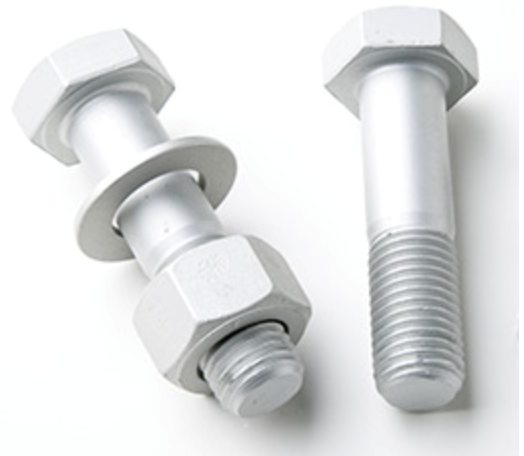
Zinc flake coating is a next-generation coating applied using the dip-spin process—immersion and centrifugation followed by thermal curing. Unlike hot-dip galvanizing, it is not a molten zinc immersion process, but rather the application of thin layers of zinc flakes suspended in an aqueous solution.
Laurentcoat® is the zinc flake coating technology developed by Chousa, specifically suited for structural fasteners.
Key Advantages for Structural Fasteners
Controlled Coating Thickness A thin, uniform coating that does not alter the dimensional tolerances of the threads. No thread re-tapping is required after coating.
No Hydrogen Embrittlement As a non-electrolytic process, it does not introduce hydrogen into the part. This is especially important for high-strength bolts such as A490 and A354.
High corrosion resistance Up to 1,000 hours in salt spray testing (ASTM B117), significantly outperforming hot-dip galvanizing in standardized testing.
No Sticking of Components Washers and flat components leave the process separated and ready for use. No rework. No delays during installation.
Uniform Coverage The dip-spin process provides consistent coverage over all areas of the component, including threads, cavities, and complex geometries.
Compliance with Standards Complies with ASTM F1136 and ISO 10683, the reference standards for zinc flake coatings used on structural fasteners.
Comparison Table
| Criterion | Hot-Dip Galvanizing | Zinc flake Laurentcoat® |
| Coating Thickness | 45–85 microns | 5–12 microns |
| Corrosion resistance (NSS) | 500–700 hours | Up to 1,000 hrs |
| Hydrogen Embrittlement | Risk due to acid pickling | No risk |
| Dimensional Tolerances | Affects threads — requires thread re-tapping | Does not alter tolerances |
| Sticking of Flat Components | Frequent | Does not occur |
| Coverage on Complex Geometries | Variable | Uniform |
| Reference Standards | ISO 1461 | ASTM F1136 / ISO 10683 |
Industry Applications
Steel Construction
In warehouses, bridges, industrial structures, and steel buildings, structural fasteners remain permanently exposed to outdoor conditions—rain, humidity, temperature variations, and atmospheric pollution.
In this context, a fastener failure is not only a maintenance issue. It can compromise the structural safety of the entire installation. The cost of replacing corroded fasteners in an already assembled structure—scaffolding, labor, and downtime—far exceeds the cost of selecting the correct coating system from the beginning.
Zinc flake coating provides higher corrosion resistance and longer service life than hot-dip galvanizing, reducing maintenance frequency and long-term operating costs.
Mining
Steel structures used in mining environments operate under particularly aggressive conditions: extreme humidity in underground extraction areas, soils with high concentrations of salts and minerals, exposure to process chemicals, and wide temperature variations in mountainous regions.
In this environment, premature corrosion of structural fasteners can result in unplanned shutdowns, high maintenance costs, and operational safety risks. Every hour of downtime in a mining operation costs far more than the value of the fastener itself.
Zinc flake coating, with up to 1,000 hours of salt spray resistance and a non-electrolytic application process, is the alternative best suited to meet the demands of mining environments.
Electrical Power
Transmission towers, substations, and transformer support structures use fasteners that operate continuously outdoors, exposed to humidity, industrial pollution, and constant thermal cycles.
In this industry, system reliability is non-negotiable. A failure in a structural fastener can interrupt service and directly affect the continuity of the electrical supply. Laurentcoat® also complies with electrical utility specifications such as EDENOR 1500 – ET-100048 and EDESUR 15000, facilitating technical approval for electrical infrastructure projects.
Conclusion
Hot-dip galvanizing is a proven and effective solution for many structural applications. However, for structural fasteners—where dimensional tolerances, mechanical strength, and long-term reliability are critical—zinc flake coating offers clear advantages that justify its adoption.
Higher corrosion resistance, no hydrogen embrittlement, no thread re-tapping, and no sticking of flat components. A solution specifically designed to meet the demands of structural fasteners used in challenging industrial environments.
Do You Work with Structural Fasteners and Want to Evaluate the Right Corrosion Protection System for Your Application?
You can contact us at info@chousa.com.ar and connect with our technical team.